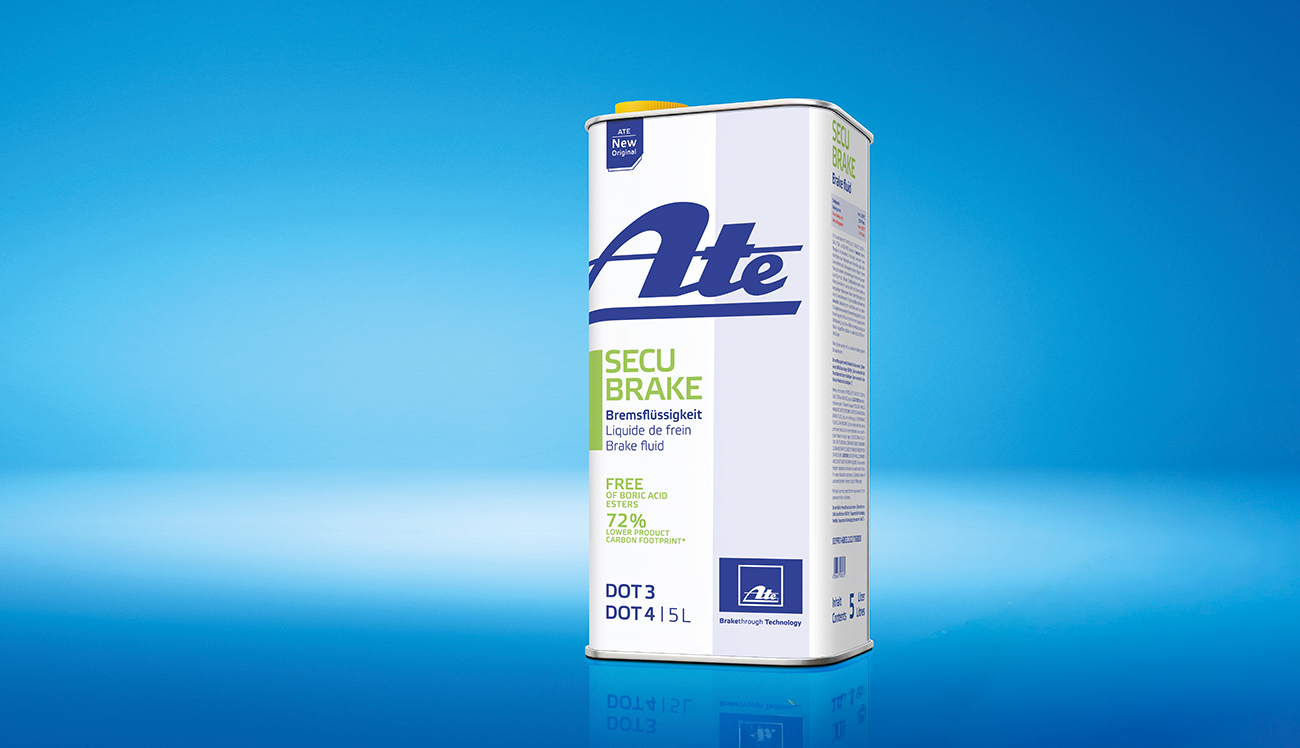
ATE SecuBrake – without boric acid esters,
But with a 72% lower carbon footprint.*
ATE SecuBrake meets and exceeds the requirements of FMVSS § 571.116 / DOT 3 / DOT 4, SAE J1704 and ISO 4925 Class 4 – without boric acid esters.¹ For your workshop, this means a reliable brake fluid that is free from hazardous substances requiring labelling, with no legally mandated protective measures for handling and storage. The product carbon footprint of ATE SecuBrake is 72% lower than that of ATE SL DOT 4.*
Made for the brake. Designed for the workshop.
ATE SecuBrake delivers full DOT 4 performance. What's new is what it saves you. Boric acid esters are the reason conventional DOT 4 brake fluids are labelled as hazardous substances. ATE SecuBrake does without them – and therefore without the regulations that come with them.
Benefits for workshops
- Free from boric acid esters and therefore without GHS classification H361fd (“Suspected of damaging fertility. Suspected of damaging the unborn child.”)
- Free from hazardous substances requiring labelling
- No legally mandated protective measures for handling and storage
- Boiling point min. 260 °C, wet boiling point min. 155 °C
- Miscible with DOT 3, DOT 4 and DOT 5.1; replacement for DOT 3, rubber compatibility ensured – except at extremely low sub-zero temperatures (lower viscosity at –40 °C)
Winner of the German Innovation Award 2025
From the jury's statement: “ATE SecuBrake is the first brake fluid to be presented that meets the legal requirements of DOT 4 standards without the use of boric acid esters. […]”

¹ All criteria are met, except for the requirement for boric acid esters.
* Compared with ATE SL DOT 4. CO2 footprint calculated according to ISO 14067:2018 with the same system boundaries and the same product unit in the reference period from January 2025 to March 2026.

German Innovation Award 2025 Winner
At a glance
- Free from boric acid esters
- 72% lower carbon footprint*
- German Innovation Award 2025
Further information on the production process
- The sustainable production process uses "green" carbon from natural bio-waste (e.g. from biogas plants), which is obtained through chemical conversion. ISCC PLUS certification ensures that the entire process is designed sustainably.
- The CO₂ saving is determined by the PCF (product carbon footprint) value, which quantifies a product's climate impact using the mass balance approach.